Tuesday afternoon was spent at Cookham Dean CofE School with Mr Edmonds' Year 3 class. This was the first session of an art project based around the theme of WWI. The class had been working hard and had already learnt lots of information about WWI and how it started.
As a group we talked about how we remember what happened in WWI. What type of things do we get our information from and how is the war commemorated? We looked at the use of art to remember and commemorate WWI. Some of the things we talked about were war memorials, statues, war paintings, poetry, videos, television and films.
We then learnt about Paul Nash, who was a famous painter who became an official war artist during WWI. After learning about his life, how he became an artist and his role in WWI, in groups we looked at some of his paintings.
The paintings we looked at were:
"The Menin Road"
"Spring in the Trenches"
"The Mule Track"
"Ypres Salient at Night"
"We are making a new world"
Each group were then given time to do some 'free' drawing where they wrote on the piece of paper anything that came into their mind, inspired by Paul Nash's paintings.
Next week Mr Edmonds class will be visiting Maidenhead Heritage Centre to find out more about WWI and learn about the Home Front.
Wednesday, 14 May 2014

Riverside Primary School
As part of the project Mrs Fitzgibbon's Year 5 class have been looking at the topic of 'Changing Sounds'. We started the session by introducing the project and the students were told we would be working on an art project so we began by thinking about the question 'what is art?'
We then looked more in-depth at music as an art form. The students closed their eyes whilst listening to an orchestra playing at the proms. They imagined all the different instruments playing. After the music stopped they were asked which instruments they could hear - violins, pianos, trumpets and cymbals! We then set about answering the question "can we still make music if we have no instruments?"
The answer is definitely yes!
Year 5 were given time to prepare a song in small groups using no instruments or objects and they then performed their songs for the rest of the class. Using clapping hands, clicking fingers and whistling one group performed a rendition of Twinkle, Twinkle Little Star whilst another group performed Three Blind Mice. Some groups even made up their own songs!
The groups were then given the same task, but this time they were given random objects to use as instruments! Paper plates, toilet rolls, pencils, paper cups, elastic bands and even tin foil were all used to produce sounds! We also watched some videos of a composer called Diego Stocco who makes music from everyday things! You can find out more about him here http://www.diegostocco.com/
After learning that musical instruments can be made from materials we find in our everyday environment we then looked at some instruments from different countries. We talked about what they were made of and tried to guess how they were played and what they might sound like.
We looked at a pagang from the Penan people in Borneo, Malaysia and a nose flute from the Nambiquara people who live in the Amazon rainforest in Brazil. These objects are from Eton College Natural History Museum and are part of a collection of objects which were brought back to England from all over the world by an explorer called Robin Hanbury-Tenison.
Here's what Mrs Fitzgibbon's Year 5 class had to say:
Next week we will be making our own musical instruments!
We then looked more in-depth at music as an art form. The students closed their eyes whilst listening to an orchestra playing at the proms. They imagined all the different instruments playing. After the music stopped they were asked which instruments they could hear - violins, pianos, trumpets and cymbals! We then set about answering the question "can we still make music if we have no instruments?"
The answer is definitely yes!
Year 5 were given time to prepare a song in small groups using no instruments or objects and they then performed their songs for the rest of the class. Using clapping hands, clicking fingers and whistling one group performed a rendition of Twinkle, Twinkle Little Star whilst another group performed Three Blind Mice. Some groups even made up their own songs!
The groups were then given the same task, but this time they were given random objects to use as instruments! Paper plates, toilet rolls, pencils, paper cups, elastic bands and even tin foil were all used to produce sounds! We also watched some videos of a composer called Diego Stocco who makes music from everyday things! You can find out more about him here http://www.diegostocco.com/
After learning that musical instruments can be made from materials we find in our everyday environment we then looked at some instruments from different countries. We talked about what they were made of and tried to guess how they were played and what they might sound like.
We looked at a pagang from the Penan people in Borneo, Malaysia and a nose flute from the Nambiquara people who live in the Amazon rainforest in Brazil. These objects are from Eton College Natural History Museum and are part of a collection of objects which were brought back to England from all over the world by an explorer called Robin Hanbury-Tenison.
Here's what Mrs Fitzgibbon's Year 5 class had to say:
- "I enjoyed making music"
- "I enjoyed hearing music"
- "I enjoyed playing with objects and making sound with them"
- "I have learnt that there are instruments that are played by your nose!"
- "I learnt you can make music with all sorts of stuff"
- "I learnt that Diego Stocco uses everyday things to make music"
Next week we will be making our own musical instruments!
Monday, 5 May 2014
Larchfield Primary School
As part of the Slough, Windsor and Maidenhead Museum Learning Project, Mrs Johnson's Year 4 class from Larchfield Primary School have been working on a 4 week project focusing on Ancient Egypt.
We began the project by looking at the question 'what is art?'. After a discussion the students realised that there are many different art forms that we see everyday!
The students then created a mind map of the different types of ‘art’
in Ancient Egypt, as this is the topic for our project. They came up with things such as the architecture of
the pyramids, the jewellery and hieroglyphics.
Hieroglyphics was the Ancient Egyptian writing system. Egyptians used pictures to represent different objects, actions, sound or ideas. There were over 600 hieroglyphs because they represented letters, sounds and even whole words! Year 4 learnt how to write their name in Hieroglyphs and then used an art technique called collaging to create a cartouche (A cartouche is an oval frame which surrounds the hieroglyphics that make up the name of an Egyptian God or royal person, it is meant to protect against evil spirits.)
Creating the collage cartouches...


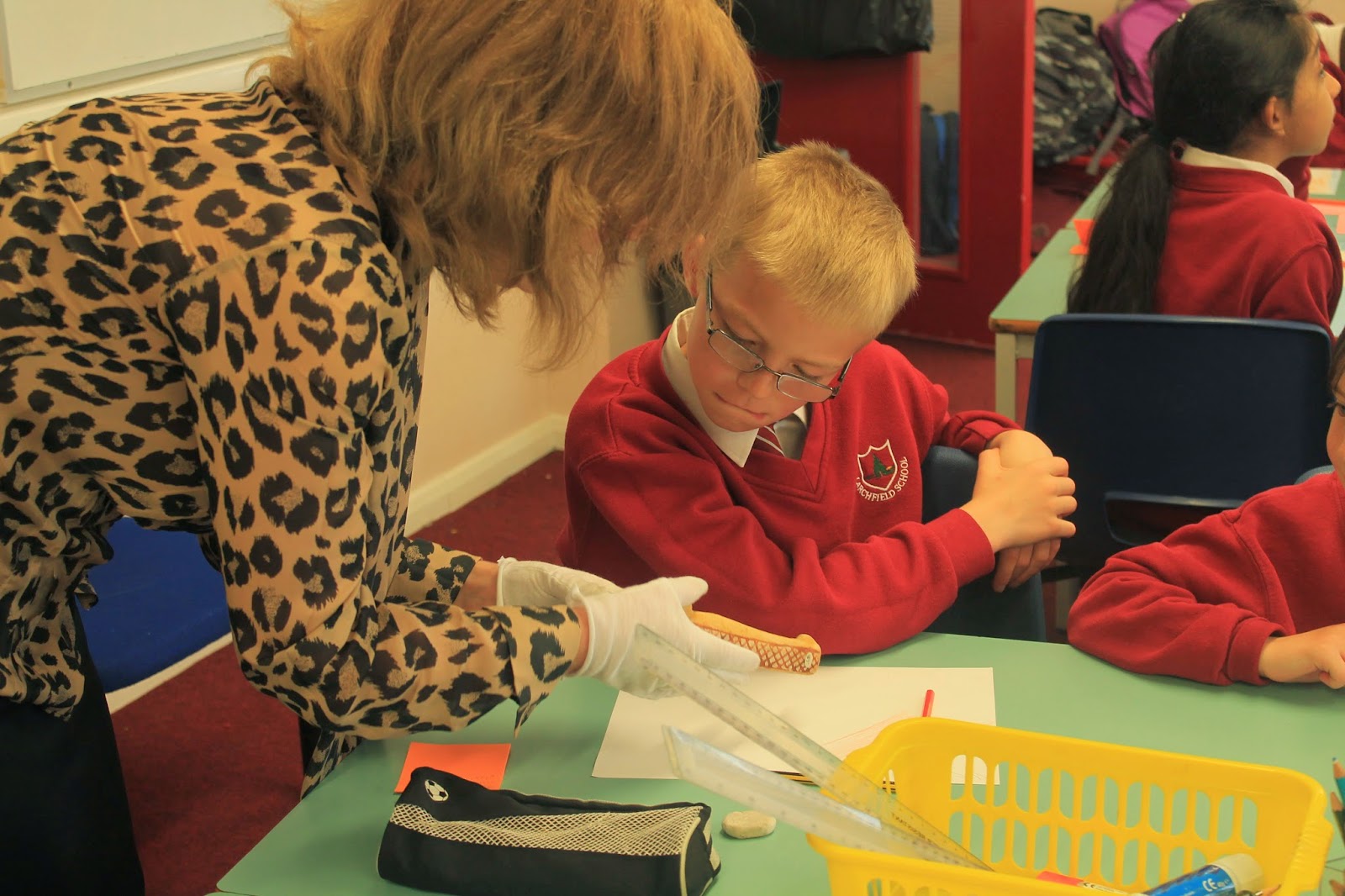
The following week we were joined by Charlotte and Rob from Eton College Collections. Charlotte is an Exhibitions Officer and Rob is the Curator of the Ancient Egypt Collection. The
children experienced a ‘tour through a tomb’ and were shown mummified hands, scarab beetles, amulets, surrogate mummies and canopic jars. There was even a piece of bread from Egyptian times!
 |
| Hieroglyphics |
 |
| A piece of a canopic jar |
 |
| mummified hand |
 |
| A surrogate mummy! |
 |
| A mummified hand! |
 |
| A piece of bread from Ancient Egyptian times! |
As well as learning lots of new facts about Ancient Egyptians, we also learnt about working in a museum. The children prepared a list of questions to ask Charlotte and Rob about what it is like to do their job.
We found out that curators wear white gloves when handling objects because they don't want to pass on the dirt and grease on their hands to the objects (some of which are 4,000 years old!). We also learnt that depending on the type of exhibition, it can take about 9 months to put on an exhibition. Sometimes it can nerve-racking being responsible for such important objects! Finally, we learnt that most people's favourite objects to see in a museum are the ones that tell a story and get people interested in the topic!
Wednesday, 30 April 2014
Slough, Windsor and Maidenhead Museum Learning Project
 |
| Wraysbury Primary Year 1 learning about Joseph Banks through objects from Eton College Natural History Museum |
The museums in the Slough, Windsor and Maidenhead (SWM) Museum Learning Project consortium are Eton College Museum Collections, Maidenhead Heritage Centre, River and Rowing Museum, Slough Museum, Stanley Spencer Gallery and Windsor Museum.
These museums will be partnering with 8 local schools to build sustainable partnerships through a creative project based on objects in the museum's collections.
The schools involved in the project are All Saints CE Junior School, Cookham Dean CE School, Islamic Shakhsiyah Foundation, Khalsa Academy, Larchfield Primary, Parlaunt Park, Riverside Primary and Wraysbury Primary.
A range of creative activities will be undertaken through the project involving drama, dance, visual arts and music! At the end of the project, students will recieve an Arts Award qualification.
The project will enable schools to think creatively about how
to enrich their
curriculum and museums to review their offer to schools.


Subscribe to:
Posts (Atom)